More international than most Tokyo nightlife districts
English is relatively common around nightlife venues, and it’s normal to see travelers, international residents and Japanese customers mixing in the same district.
Roppongi is one of Tokyo’s most international nightlife districts: bars, clubs, late-night restaurants, hotel lounges, travelers, international residents and locals — packed into an area where changing the night usually means walking a few minutes, not crossing Tokyo.
This guide covers what it’s actually like, the venues I’d genuinely use for different kinds of nights, what changes after the last train, how Roppongi compares with Shibuya and Shinjuku, and how to choose the next room when the night changes.
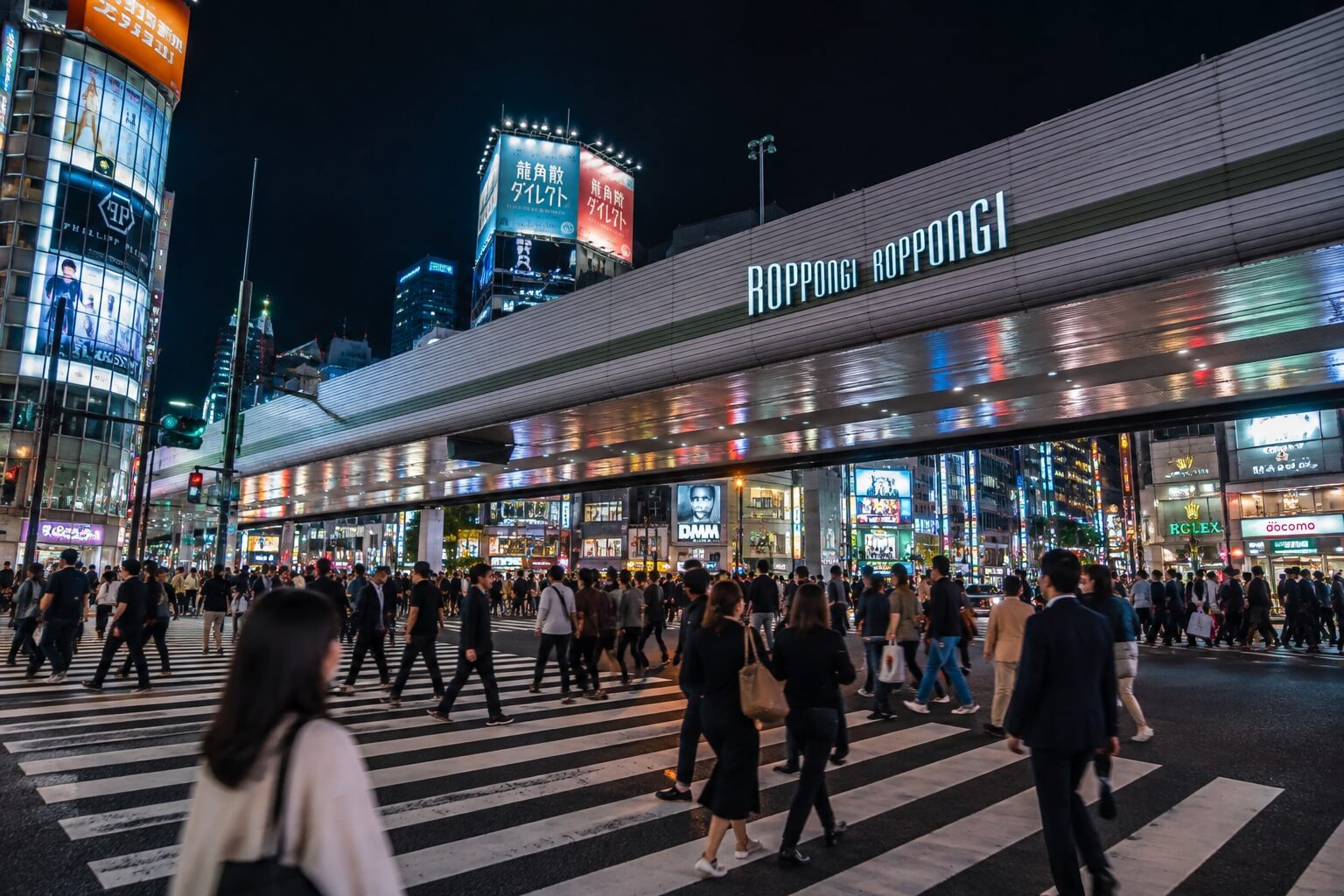
Roppongi’s biggest advantage is variety packed into a relatively small area. You can start in a casual bar, move somewhere louder, end up in a club, and still be within walking distance of your previous stop.
After enough nights here, you notice that changing venues does more than change the music. Walking to the next place breaks up fixed seating and groups, puts different people beside each other, and gives a flat night a small social reset. Roppongi’s compact layout is unusually good for that kind of movement.
English is relatively common around nightlife venues, and it’s normal to see travelers, international residents and Japanese customers mixing in the same district.
Roppongi is good for a multi-stop night rather than committing to one place. Many venues are close enough that changing atmosphere takes only a few minutes.
Early evening can feel surprisingly calm. Around 10 PM onward the nightlife becomes more obvious, and after the last trains the remaining crowd becomes more committed.
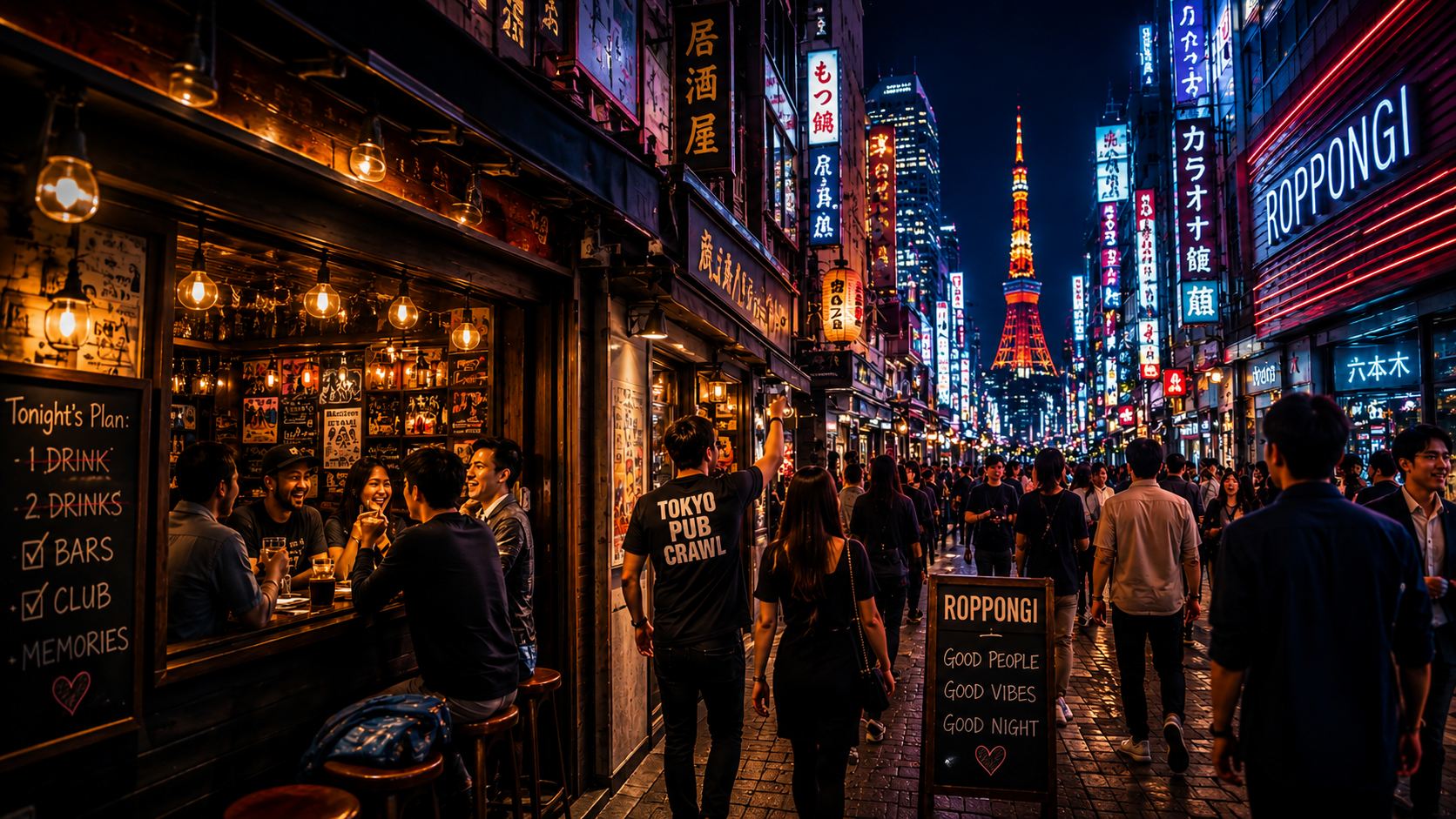
Once you understand the district, this is the useful decision tool: the “best” venue changes depending on whether you need conversation, social momentum, music, or somewhere that still works after midnight.
Tap what you want. The route beside it changes into a practical way to shape the night.
Six venues, six different jobs. There is no single “best bar” here. These places make sense at different hours and for different crowds. I know them from years of running nights in Roppongi, so this is a practical shortlist rather than a ranking.
Tap a room. Find the atmosphere
your night needs next.
Western-style dive-bar energy, a mixed international crowd and an easy room to start in. It can feel relaxed earlier and much livelier once the weekend gets moving.
Hip-hop-focused with DJs that are actually worth paying attention to. A stronger music choice than a generic “international bar” when the group wants the energy to go up.
Shisha, lounge seating and a more relaxed pace. Useful when you want to slow the night down, sit for a while or actually hear the people you are with.
An after-hours kind of place with good music that makes more sense very late than as an early-evening first stop. It is one of those rooms that can become useful once the normal bar night is already over.
A proper large club rather than a bar pretending to be one: bigger production, a real dance floor and international DJs. It is also comparatively easy for foreign visitors to understand and enter.
A good late-night club once Roppongi has moved past the bar-hopping part of the night. The DJs are a strong reason to go, and it tends to make more sense after midnight than as an early stop.
An illustrated collection, not a real building or map. These venues are in separate locations; room order is not a ranking or pub crawl route.
The price marks are a rough relative guide, not quoted menu prices. Covers, drink prices, hours and door policies can change, especially at clubs and special events. Check the venue before you go.
A place that is perfect at 8 PM can be wrong at 11 PM, and a loud club that works brilliantly for an established group can be terrible for three people who still need to talk.
Choose somewhere smaller, quieter or more communal. Conversation needs less volume and fewer closed tables.
Change the room. A short walk and a different layout can reshuffle people and reset the social rhythm.
Do not move because an itinerary says you should. Sometimes the right decision is to let a good room keep working.
Move toward music and dancing after the group has enough connection to enjoy a louder room together.
There isn’t a universal “best nightlife area.” They solve different problems. Roppongi is strongest when you want international, social, multi-stop nightlife without spending the night crossing the city.
Compact, mixed and useful when meeting people or moving between several different room types matters.
Open Roppongi map →Busier, younger and stronger for mainstream club energy, big crowds and a more trend-driven night.
See Shibuya →Huge range: tiny bars, Golden Gai, Kabukicho, izakaya, karaoke and very different pockets close together.
See Shinjuku →Yes, you can. The trick is choosing places designed for interaction rather than trying to manufacture conversation in a room where everyone arrived with their own group. Do not cold-start in the hardest room.
Bars with counter seating, international crowds or organized social events give you a much easier first interaction than walking straight into a packed club.
Arriving before everything becomes loud gives you time to actually meet people before the night turns into mostly music and movement.
Pub crawls and social events remove the hardest part: finding the first group to join. Once you’ve met a few people, the rest of the night gets dramatically easier.
Want the deeper version? Read the Tokyo Solo Nightlife Guide →
Tokyo nightlife is strongly shaped by the train system. Around midnight, your night tends to divide into “go home soon” and “we may be here until morning.” Roppongi has clear phases on either side of that decision.
Good for dinner, first drinks and actually hearing the person next to you.
Bars fill up and people begin moving between venues.
People watching the clock start peeling away for trains. Others are clearly staying out.
Clubs, karaoke, late-night bars and food take over until early-morning transport resumes.
Roppongi is a major nightlife district, so the same common-sense rules that matter in nightlife areas anywhere matter here too. Three rules matter more than twenty generic warnings.
You do not need to follow a street tout into a venue you had not planned to visit. If a place feels wrong, simply keep walking.
Cover charges, table charges and minimum orders vary. Ask if you are unclear rather than discovering the answer after five drinks.
Maps, train routes, translation and contact with friends all become more important, not less important, at 1 AM.
Tokyo Pub Crawl starts in Roppongi and moves through multiple venues with an international group. The current format includes several bar stops, followed by a club stop for guests who want to continue the night.
Short answers to the questions people usually need before deciding whether Roppongi fits their night.
Yes. Its international nightlife scene and relatively compact layout make it one of the easier Tokyo nightlife districts for visitors to navigate.
It can be. Social bars, counter seating, international events and group nightlife formats are generally easier for solo visitors than large venues where everyone arrives with friends.
For bars and socializing, early-to-mid evening works well. Clubs and louder venues generally become more active later. Exact busy times vary by venue and day.
Many nightlife venues operate late, but hours vary. If you miss your last train, check the specific venue’s opening hours and your first-train route rather than assuming every place stays open.
It depends on what you want. Roppongi is particularly strong for international nightlife and multi-stop nights. Shibuya tends to feel younger and larger-scale, while Shinjuku has an enormous variety of micro-scenes.
Choose a format built around interaction: a social bar, counter seating, an international event or a group activity such as a pub crawl. The environment matters more than simply picking the busiest venue.
A plain building can hold completely different bars on several floors. Street level is only part of the nightlife.
バー = bar · ラウンジ = lounge · カラオケ = karaoke. The directory often tells you what is upstairs.
Cover, table and minimum charges vary. Clarifying first is easier than arguing later.
Pick your own venue. If someone pushes you toward somewhere you did not choose, keep walking.
Train-watchers leave and the stay-out crowd commits. Make your transport decision before options shrink.