20+Bring the actual valid physical ID if you plan to club — some venues will not accept a photo, copy or expired ID.
Last trains
Roughly midnightThere is no universal last train. Check your exact route that night.
Street drinking
Usually allowed — with local exceptionsHaving a drink outside is generally permitted in Tokyo, but designated central Shibuya areas ban public drinking from 6pm to 5am. Wherever you are, keep it considerate.
Best nightlife areas
Pick one districtRoppongi, Shibuya and Shinjuku each feel very different after dark.
Biggest avoidable mistake
Following a toutChoose your own venue. Never let a street promoter lead you somewhere unknown.
Tokyo Nightlife Areas: Which Fits You?
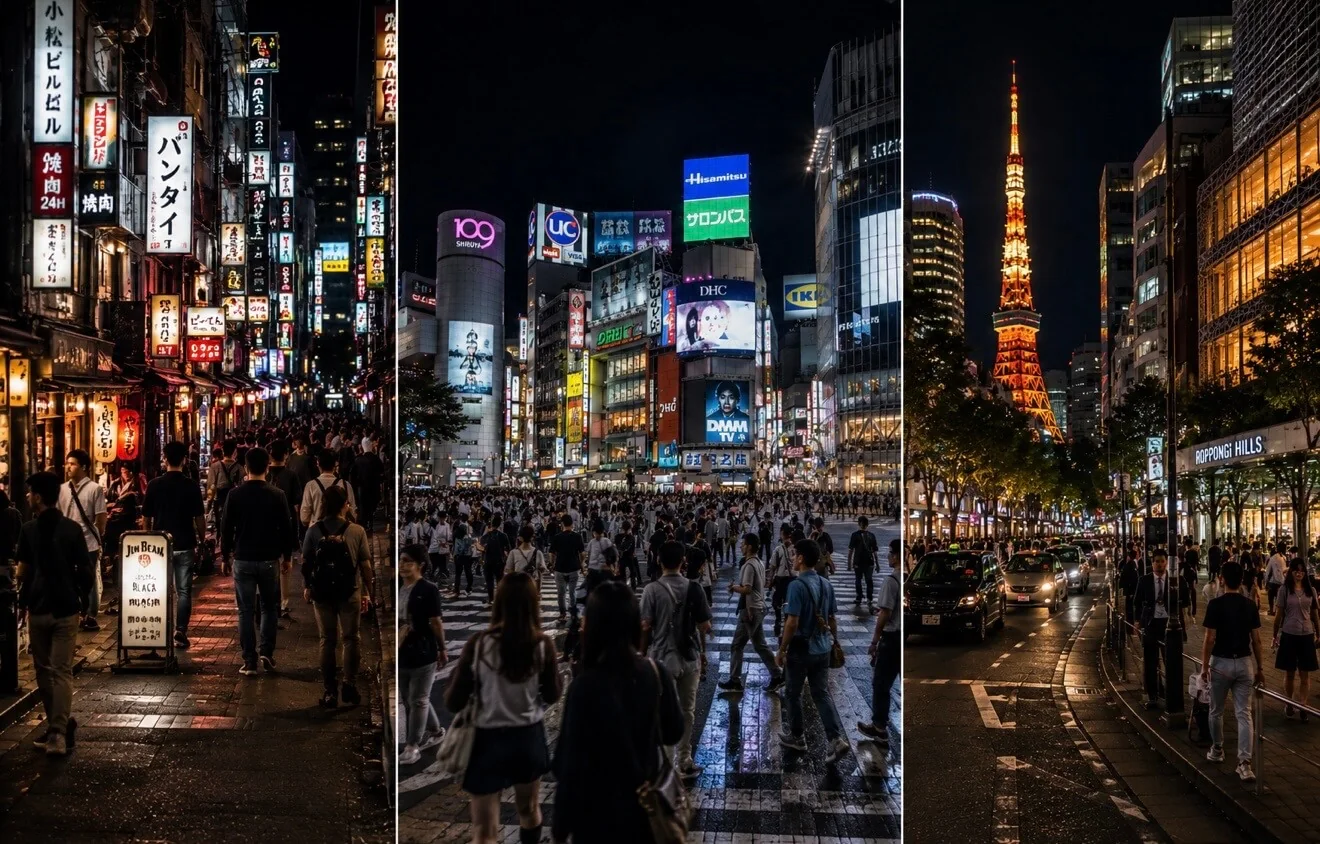
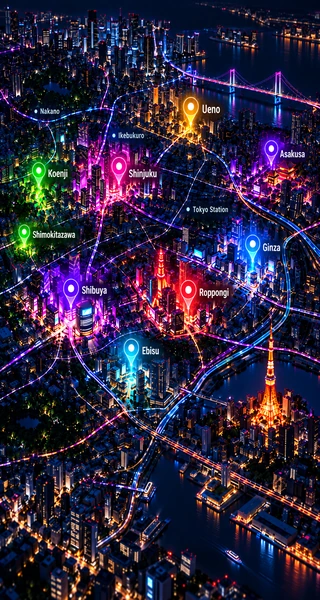
Tokyo does not have one single nightlife center. Pick the area that matches the kind of night you want.
R
Roppongi
International / Social
Best for visitors who want an international crowd, English-friendly nightlife
and a social night where meeting people is relatively easy. Our
Roppongi nightlife guide goes deeper into
social bars, club nights and choosing your next venue.
High-energy, younger and more trend-driven, with clubs and bars around
Center-Gai, Dogenzaka and Maruyamacho. It is strong for music and club culture.
In the designated Shibuya Station area, street drinking is banned from 6pm to 5am daily.
The broadest mix: Golden Gai, Kabukicho, izakaya, karaoke and the
LGBTQ+ nightlife of Shinjuku Ni-chome. Best when you want variety rather than
one single scene. In Kabukicho especially, ignore street touts and pick venues yourself.
Compare Shinjuku’s nightlife zones →
Tokyo can feel extremely polite while also feeling socially reserved. From years of living and working around Japanese people, I have repeatedly seen people who studied English for years still say “I can’t speak English” because they are uncomfortable making mistakes in public. That hesitation should not automatically be read as unfriendliness.
When this guide talks about an area being English-friendly, I mean how easy it is to function and socialize there mainly in English — not how friendly the Japanese people in that area are. Those are different things.
Choose by mood: meeting people, dancing or a quieter night+
Choose the Night — Not Just the Neighborhood
The most useful question is not simply “Which area is best?” It is what you actually want the night to do for you.
Meet peopleStart socialChoose a counter bar, communal venue or hosted event before the room becomes too loud for easy conversation. See the full Meet People in Tokyo guide →
DanceBuild toward itMeeting one or two people somewhere conversational can make arriving at a large club dramatically easier.
ExploreChoose varietyPick a dense neighborhood with several kinds of venues and leave enough room for your plans to change.
A polished nightSlow the paceDinner, a hotel bar or a serious cocktail bar can be a complete Tokyo night without chasing the biggest crowd.
Enjoy Tokyo aloneGo smallerA counter seat, one carefully chosen venue and a night walk can work better than forcing yourself into a giant club.
DON'T GET SURPRISED BY THE BILL
How much does Tokyo nightlife cost?
Prices vary more by venue and activity than by neighborhood. Set a realistic allowance, then check actual menus and tickets.
01 · Food first¥3,000–6,000
Izakaya evening
Suggested allowance for dinner and a couple of drinks at a casual izakaya. Shared dishes, seat charges and what you order affect the total.
02 · Small bars¥3,500–8,000
Two-bar night
Suggested allowance for drinks at two places, allowing for possible cover charges. Golden Gai can cost more per stop than it first appears.
03 · Ticketed night¥4,500–10,000+
Club or live performance
Suggested allowance for an entry ticket and drinks; major artists or premium seating can be more. Transport or late-night taxis are extra.
Planning estimates, not venue-advertised prices. Transport and late-night taxis are extra. Check menus, cover charges and tickets for your night.
Budget notes & published price examples+
Check against actual published prices:Shinjuku PIT INN lists regular evening performances from ¥3,300 including a drink; GO TOKYO's 2026 SHIBUYA SKY listing shows ¥3,400 for an online adult ticket from 15:00. These are examples from published listings, not a quote for your visit. For nightclubs such as SEL OCTAGON, admission varies by event. Prices and admission can change; confirm the listing for your visit.
SIMPLE ROUTES, NOT 14-STOP ITINERARIES
Three ways to spend a Tokyo night
See the shape of each night. Open the one that feels like you.
Small bars & food
Shinjuku, no rush
Yakitori at Omoide Yokocho, then one or two Golden Gai bars. Prefer live jazz? Make PIT INN the evening instead.
See this evening+
Early evening: start with yakitori at Omoide Yokocho.
Later: choose one or two Golden Gai bars whose door signs fit your budget and group.
Before midnight: decide whether to take your last useful train or stay in one area.
Alternative: book PIT INN for a jazz-led evening instead of trying to squeeze jazz and bar hopping into one plan.
These are example flows, not a claim that venues are open, connected or admitting guests at every step tonight. Start earlier if you want conversation, use the exact venue schedules, and check your entire last-train route before you commit.
Cash, IC cards & what to bring+
Before You Go Out
Four things that matter more than most old “Japan nightlife tips.”
Carry Some Cash — Not a Wallet Full of It
Tokyo is far more cashless than older guides make it sound. Cards and contactless
payments are common, but smaller bars and occasional payment failures still happen.
A modest amount of yen is enough for backup.
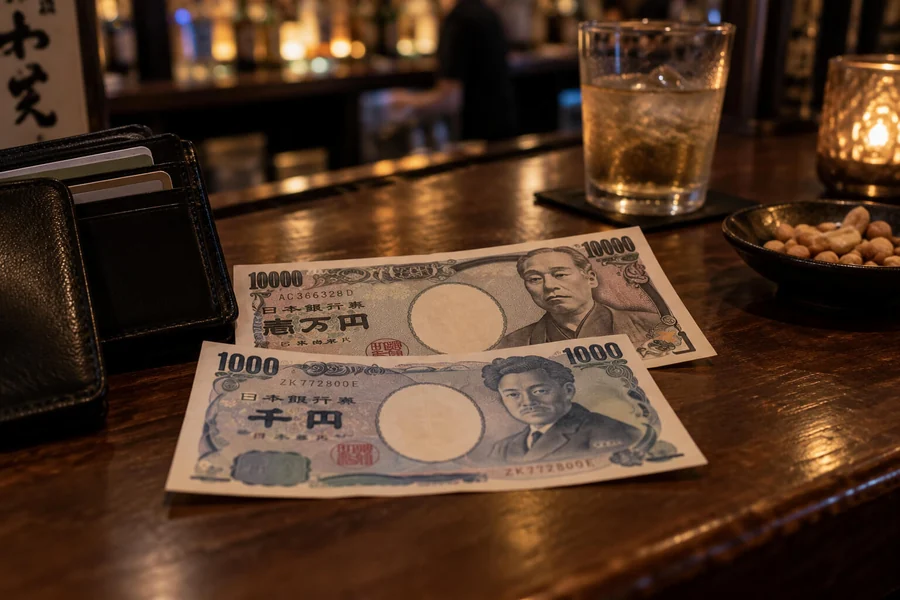
💴 Experience tip: Check those zeros
The ¥1,000 and ¥10,000 notes can be surprisingly easy to mix up in a dark bar after a few drinks. We’ve seen travelers hand over ¥10,000 thinking it was ¥1,000—and yes, we’ve done it ourselves plenty of times. 😂 Keep larger notes separate and double-check before handing one over.
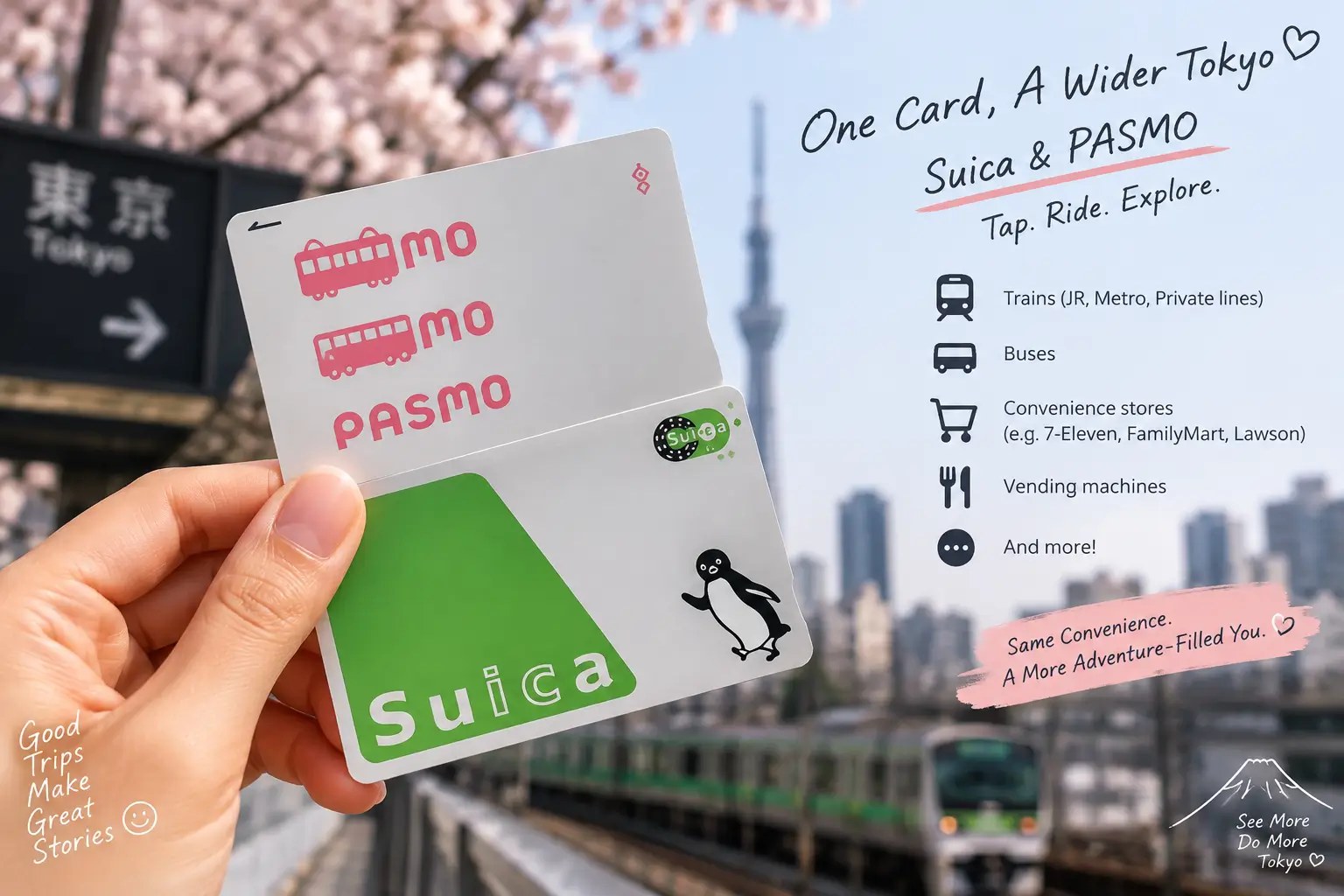
Use Suica or PASMO — Mobile If Convenient
IC cards make trains effortless and are also useful for small purchases.
Set yours up before the night starts and keep enough balance for your trip home.
💳 Our pick: Suica if you’re starting fresh
For a trip that includes Tokyo and other Japanese cities, Suica is our default recommendation. In Tokyo, Suica and PASMO work much the same, and both work across Japan’s participating IC-card networks. Already have PASMO? There’s no need to switch for travel outside Tokyo. Neither card covers every train or bus, so check your route.
📶
Use Mobile Data, Not “Free Wi-Fi Hunting”
An eSIM, SIM or roaming plan is much more useful than trying to find free Wi-Fi at 1am.
You will want reliable maps, messages, translation and taxi access.
📍
Save Your Hotel and First Venue
Pin your hotel, first bar and last-train route before you go out.
When the night gets busy, you should not be trying to remember the exact station
entrance or hotel name.
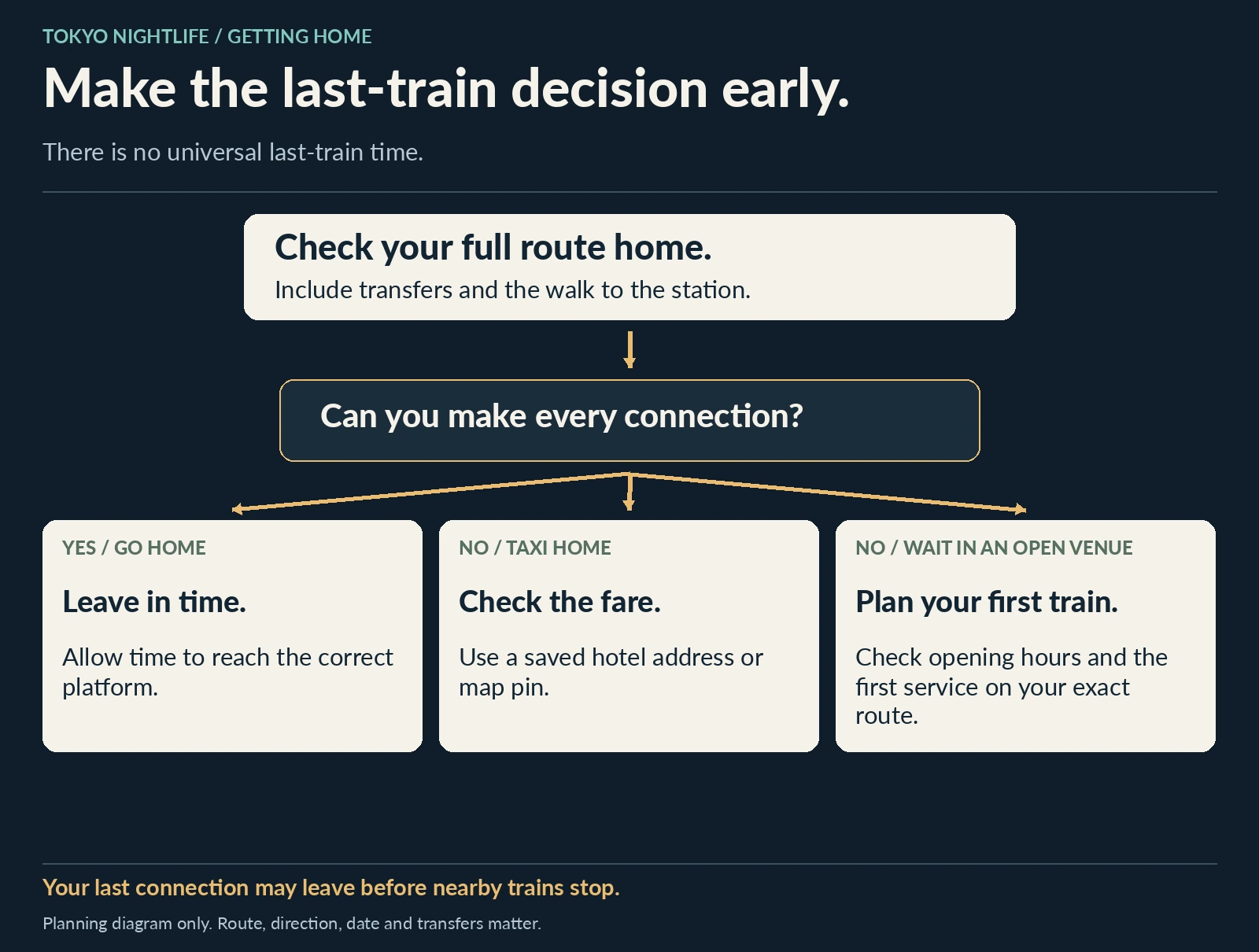
Check your complete route before going out. The decision is simple: your last train, a taxi, or the first train home.
01 / TRAIN
Know your last connection.
Check every transfer to your destination, not one citywide cutoff.
02 / TAXI
Keep a way home.
Save your hotel address and allow for the fare before deciding to stay late.
03 / STAY LATER
Choose the morning deliberately.
Use an open venue and check the first-train route for the correct day.
💡 Counterintuitive in Japan: red means available.
空車AVAILABLE
Hail this taxi
賃走OCCUPIED
Passenger aboard
回送NOT FOR HIRE
Reserved / pickup / off duty
Look for the Japanese status text: red 空車 means vacant. 迎車 / 予約 / 回送 are not available to hail. Display colors can vary on newer equipment.
Train times, taxi costs & the illustrated last-train guide+
🚃
Check the Full Last-Train Route
“Around midnight” is only a rule of thumb. Your final connection can leave earlier
than the last train from the nightlife district. Check the full route including transfers.
🌅 First trains: roughly 5–6am
Staying out until morning? Use this as a planning window, not a guaranteed 5:00am departure. Exact times depend on the station, line, direction and day.
Check the whole trip home. The first train from your station may leave you waiting for a connection. Search all the way to your hotel, not just the first stop.
Use the morning’s date. Friday night means Saturday morning’s timetable; Saturday night means Sunday morning’s. Recheck before leaving and allow time to reach the platform.
If you miss the train and your destination is reasonably close, a metered taxi is often
the simplest answer. Keep your destination saved on your phone.
💴 Rough late-night fares from RoppongiShibuya ¥2,500–3,500 · Shinjuku ¥3,500–5,000
With the current yen, that’s pretty reasonable — especially if you split it. Ueno or Asakusa? Maybe just keep the party going until the trains start again. 😂
Late-night note: Tokyo taxi fares are generally 20% higher from 10pm to 5am.
🗺️
After Midnight, Stay in One Area
Once trains stop, stay in the area where your night is already working.
🔋
Phone Battery Matters More Than You Think
Your phone is your map, train planner, translator, taxi tool and contact point.
Start the night charged and carry a small battery if you expect to stay out late.
After the Last Train
Missing the last train is inconvenient, not catastrophic. Pick the simplest option.
Open full-size image ↗A planning diagram, not a timetable. There is no universal cutoff: check the whole route, including transfers and the correct travel date.
Stay Where the Night Is Already Working
Clubs, karaoke and late-night bars can carry you through until first trains restart.
🕔
Missed the Train? Simplify
Taxi home if the fare is reasonable. If it is not, stay where you are until the trains restart.
Tokyo feels easy at night — that is exactly why people sometimes get careless.
Most problems are avoidable: control your own venue choice, your drink, your phone and your route home.
Nightlife Safety & Etiquette
Tokyo is generally easy to enjoy. The useful advice is specific, not dramatic.
DO
Choose venues yourself and check the address before entering.
Keep your drink and phone with you.
Save your hotel and route home before the night gets busy.
Use a taxi if the last train is gone and the fare is reasonable.
Use a koban or call 110 if you genuinely need police assistance.
DON'T
Follow street touts offering “special” bars, girls or club deals.
Assume old advice saying you can drink anywhere in public is still correct.
Get so intoxicated that you cannot navigate home or judge a situation.
Cross Tokyo by taxi after midnight just because another district “might be better.”
Leave valuables unattended on counters or tables.
Street drinking: the local rules and etiquette+
Street drinking: legal does not mean anything goes
Having a beer or chu-hai outside is generally permitted in Tokyo. The important nightlife
exception is designated central Shibuya, where drinking in streets, parks and other public
spaces is prohibited every day from 6pm to 5am.
Elsewhere, enjoy the freedom without turning the sidewalk into a drinking contest. This is
still Japan: keep the noise reasonable, do not block people, clean up after yourself and do
not get so drunk that your night becomes everyone else's problem.
Four Mistakes That Make Tokyo Nightlife Harder Than It Needs to Be
These cause more trouble than obscure etiquette rules.
01
Trying to do three nightlife districts in one night
Tokyo is huge. Pick one main area and let the night develop instead of spending it in transit.
02
Waiting until 11:55pm to think about the train
Your last useful connection can disappear before the final train leaves the neighborhood.
03
Assuming “Tokyo is safe” means nothing can go wrong
Touts, over-intoxication, lost phones and bad venue choices are still real problems.
04
Overplanning every bar
Have a starting point and a backup, then leave room for the night to change once you meet people.
Going Out Alone in Tokyo?
Tokyo is one of the easier big cities to explore solo, but nightlife is more fun when
you have structure. Start somewhere intentional, keep your route home saved, and choose
a place where talking to people feels natural before the night gets too loud.
Start somewhere intentionalA counter bar, social event or smaller venue makes the first conversation easier.
Stay socially flexibleTalk to people, but keep control of your drink, phone and next move.
Hosted nightlife removes frictionA group format solves much of the “where do I go now?” problem.
The practical stuff matters, but there is also a social side to Tokyo nights:
why strangers bond faster, why group energy changes, and why a good night often depends more on people than the venue itself.
Not a rule — just a useful way to think about the rhythm of a night out.
6:00–7:00pmDinner, izakaya, first drinks
Start with food, casual drinks and somewhere you can actually talk.
7:00–11:00pmBars, socializing and bar hopping
This is the easiest part of the night for meeting people and changing venues while trains are still running.
11:15pm–midnightMake the last-train decision early
Do not wait until the platform closes. Train home, taxi home, or commit to the night — decide before midnight.
After midnightClubs, karaoke and late-night bars
If you stay out, choose places close together, keep your phone charged and avoid unnecessary cross-city taxi rides.
Around 5:00–6:00amFirst trains begin again
Exact first-train times vary by line, so check your route before leaving the venue.
Explore more
Tokyo Nightlife Guides
SWIPE TO EXPLORE
Swipe horizontally, use the arrow buttons, or use the left and right arrow keys. Select a side card to bring it to the center. Open the centered card to read its guide. A complete list is available below.
A real listening-first option with scheduled jazz performances. Choose it because the musicians interest you, not because you want to strike up conversations all night.
Good to know: Shows are ticketed and times vary. Reserve when appropriate; check the lineup and the venue’s official schedule.
A multi-floor music club in Maruyamacho. Choose WOMB for the DJ and sound, especially if you genuinely like the style of that night’s event.
Good to know: Check the specific lineup, start time, advance tickets and valid-photo-ID policy. A big dancefloor is not automatically an easy place to meet strangers.
English and Japanese stand-up near Dogenzaka. A practical alternative for travelers who want a social evening but not necessarily a drinking-heavy one.
Good to know: Book the show you want and confirm the language and time. It is a performance, not an all-night dance venue.
These are independently operated venues, not a guaranteed Tokyo Pub Crawl route. For a deeper neighborhood guide, see Roppongi nightlife and venue details →
START SOCIAL
Bar Propaganda
¥
Western-style dive-bar energy, a mixed international crowd and an easy place to begin. Relaxed earlier; livelier as the weekend gets going.
Good to know: Best when: you want conversation to happen naturally.
If you prefer a booked concert to bar hopping, this Tokyo Midtown venue is the more intentional, seated live-music choice. Confirm the performer, ticket and reservation terms first.
Also worth considering: Ginza for cocktail bars; Ueno / Ameyoko for informal izakayas; Shimbashi and Yurakucho for drinking streets. Explore all nine nightlife areas →
This is an editorial selection, not a paid directory. Tokyo Pub Crawl operates in Roppongi, so our perspective has a disclosed bias. These are independent venues, not promised pub crawl stops. Cost symbols are relative, not price quotes. Always confirm current entry terms, opening hours, lineups and restrictions.
What Is a Tokyo Pub Crawl?
Meet people before the club. Hosted social bar hopping on Friday and Saturday in Roppongi, with introductions and the route handled for you.
Tokyo Pub Crawl is our hosted social bar-hopping night in Tokyo. Most regular Friday & Saturday
events currently start in Roppongi, but Tokyo is the experience. The group moves through several
venues together, while hosts make introductions and keep the night moving. You can join the social
parts you like, move at your own pace, and let the structure remove the awkward “where do we go now?” part.
OPTIONAL VIDEO
See the hosted format in context
This video is about Tokyo nightlife more broadly. It starts here at the short segment that shows
what Tokyo Pub Crawl looks like in practice, if you want a little more context.
Tokyo nightlife is spread across distinct districts rather than one central strip. Shinjuku is strongest for variety and tiny bars, Shibuya for younger music and club energy, and Roppongi for international, social nightlife. Most nights work better when you choose one main area, start with food or bars, and move later if you want something louder.
What time does nightlife start in Tokyo?
Tokyo nightlife usually starts with dinner and bars around 7–9 PM, while larger clubs tend to get busier later. If you want to meet people, starting earlier is easier because venues are quieter and you still have time to decide whether to catch the last train or stay out.
Can foreigners go to bars and clubs in Tokyo?
Yes. Foreign visitors can go to most Tokyo bars and clubs, but each venue sets its own entry rules, ID requirements, dress code and charges. Bring valid photo ID, check the venue before you go, and avoid following street touts into unfamiliar places.
Where is the best nightlife in Tokyo?
It depends on the kind of night you want. Roppongi is easiest for an international, social night; Shibuya is stronger for younger club and music culture; and Shinjuku has the widest mix of bars, entertainment and late-night options.
Is Tokyo nightlife safe?
Tokyo is generally comfortable for a night out, but nightlife still needs normal precautions. Avoid street touts, keep control of your drinks and belongings, know how you are getting home, and leave any venue or situation that feels wrong.
What should I wear to clubs in Tokyo?
There is no Tokyo-wide dress code. Many bars are casual, but clubs can refuse overly casual or unsafe clothing such as beach sandals, and special events may have their own rules. Check the venue before you go and choose clean, going-out clothes and closed shoes if you are unsure.
Do Tokyo clubs check ID?
Yes, many major clubs check ID at the entrance. Bring a valid government-issued photo ID and do not rely on a photo or copy being accepted. The legal drinking age in Japan is 20, and individual venues may have stricter entry rules.
How much does it cost to go clubbing in Tokyo?
For a normal club night, a practical starting budget is roughly ¥2,000–¥5,000 for entry at many major venues, before extra drinks or transport. Weekdays can be cheaper and major guest events can cost more, so check the event page for the exact night.
What time do bars and clubs close in Tokyo?
There is no single closing time. The night can continue in clubs, karaoke rooms and late-night bars after the last trains, but hours vary by venue. Check your chosen place and your full last- or first-train route before committing to an all-night plan.
What can I do in Tokyo at night without drinking?
Night views, food, arcades, karaoke and photography can be the whole evening. Our 15 things to do in Tokyo at night include non-drinking ideas as well as social nights out.
What time is the last train in Tokyo?
It depends on the line and destination, but most train service stops around midnight.
Check your exact route the same night rather than relying on one universal time.
Can I drink alcohol outside in Tokyo?
Generally, yes — public drinking is not broadly prohibited in Tokyo, but local restrictions
apply. The major nightlife exception is designated central Shibuya, where drinking in streets,
parks and other public places is prohibited from 6pm to 5am every day. Even where it is allowed,
be considerate: enjoy a drink without turning public space into a drinking contest.
What is the legal drinking age in Japan?
20 years old.
Which Tokyo nightlife area is best for first-time visitors?
Roppongi is easiest for an international, social night; Shibuya is stronger for
younger music and club culture; and Shinjuku offers the widest variety.
What is the biggest nightlife scam to avoid?
Street touts. Do not follow people who approach you on the street offering a bar,
club or special deal.
Do I still need cash for Tokyo nightlife?
Not nearly as much as older travel guides suggest, but carrying some yen is still smart.
Should I rely on free Wi-Fi at night?
No. A working eSIM, SIM or roaming connection is much more dependable.
What should I do if I miss the last train?
If home is reasonably close, take a taxi. Otherwise stay in the nightlife district
you are already in until trains restart.
Is Tokyo nightlife good for solo travelers?
Yes, especially if you choose social areas and known venues.
Should I move between Roppongi, Shibuya and Shinjuku in one night?
Usually no. Pick one main nightlife area rather than spending the night crossing Tokyo.
Is Roppongi still worth going to in 2026?
Yes if you want international nightlife, English-friendly venues,
social bar hopping and late-night clubs.
Once you have a district, check the bar or club’s own current listing for hours, music or DJ lineup, entry charge, ID policy and reservations. Use recent map photos and reviews for context — but confirm important details with the venue before traveling.
03 / PLAN THE JOURNEY HOME
Look up the full last-train route
Check your complete hotel-bound route, including transfers and the correct day’s timetable. Start with the Tokyo Metro timetable or the operator for your line. Trains generally stop around midnight, but that is not your personal last-train time.
From hosting Tokyo nights since 2011: the best first venue is one that fits your goal and makes your second decision easy. You do not need to schedule the entire evening. Going solo? Start with a conversational room. Going out as a woman? Choose venues with clear entry terms and a return plan.
Useful Night-Out Essentials
🏧
7-Eleven ATMs Are a Good Backup
Seven Bank ATMs remain one of the easiest places for visitors to withdraw yen
with many overseas-issued cards.
🛍️
Donki Is the “I Forgot Something” Store
Chargers, umbrellas, basic clothing, toiletries and random emergency purchases —
major nightlife districts often have a Don Quijote nearby.
TOKYO INSIDER
Tokyo Insider Notes
Small things that make Tokyo easier once somebody points them out.
🍢That little appetizer may not be freeMany izakaya and small bars have a seating charge and automatically serve an otoshi appetizer. It usually is not a scam — it is part of the Japanese bar system.🚕Taxi doors open themselvesIn most Tokyo taxis, the rear passenger door is opened and closed by the driver. Let the car do it.🚉Save the exit — not just the stationAt big stations, the wrong exit can put you a long walk from your friends. Screenshot the exit name or number.📍Keep the Japanese addressA venue name in English may not help a driver. Save the Japanese address or a map pin before you start drinking.🚆Your transfer can be the real last trainA line may still be running while the connection you need has already finished. Check the complete route home.👮交番 = KOBANIf you are lost, lose something, or genuinely need police help, look for a police box marked 交番 / KOBAN.